Emergency Rescue Process Nepal
Emergency Rescue Process & Medical Evacuation Protocols
Nepal's first professional Emergency Medical Assistance Company, operating a fully equipped 24/7/365 Emergency Response Alarm Center since 2012 — licensed by the Department of Tourism, Government of Nepal.
Learn more at Alpine Rescue ServiceOperations
Mission: Save Life
About the Partnership
Our Official Partner: Alpine Rescue Service Pvt. Ltd.
The designated in-country operational arm for insurers and global assistance companies across Nepal.
Alpine Rescue Service Pvt. Ltd. is a Trademark Registered company, duly registered with the Office of the Company Registrar and licensed by the Department of Tourism, Ministry of Culture, Tourism and Civil Aviation, Government of Nepal. ARS has been operating within Nepal's legal framework since 2012, backed by Professional Liability Insurance with coverage of USD 500,000.
As the official assistance partner of Himalayan Guardian Nepal and IGI Prudential Insurance (approved by the Nepal Insurance Authority), ARS ensures controlled, medically appropriate, policy-aligned, and time-critical response execution through an integrated network of helicopter operators, hospitals, and ground resources across Nepal's complex terrain.
Recognition & Credentials
IAG Quality Award
Recipient of the International Assistance Group Quality Award (2016, Berlin) — first assistance partner to IAG for Nepal from 2014 to 2021.
2015 Earthquake Response
Executed approximately 700 flights during the Nepal Earthquake, including 400+ non-commercial rescue missions for affected communities.
50+ International Partners
Extensive operational experience working with over 50 international assistance and insurance companies worldwide.
Government Authorization
Licensed by the Department of Tourism, Ministry of Culture, Tourism and Civil Aviation, Government of Nepal.
USD 500K Liability Coverage
Professional Liability Insurance with coverage of USD 500,000, ensuring risk-managed and compliant service delivery.
Nepal's First EMA Provider
The first professional Emergency Medical Assistance Company in Nepal — Trademark Registered with OCR, licensed for foreign currency exchange by Nepal Rastra Bank.
Rescue Flights Completed
Clients Served
Years of Operations
Global Insurance Partners

Emergency Response Process
From distress signal to hospital doors.
Emergency Occurs
Distress signal triggered at altitude
SOS Received
24/7 Alarm Center activated
Case Reception
Case logged, dispatcher assigned
Initial Contact
First-aid instructions provided
Medical Assessment
Telemedicine evaluation conducted
Decision Point
Evacuation method determined
Insurance Approval
Insurer authorization obtained
Rescue Activated
Flight medics dispatched
Hospital Transfer
Patient transported to facility
Operational Framework
Verified protocols,
documented transparency.
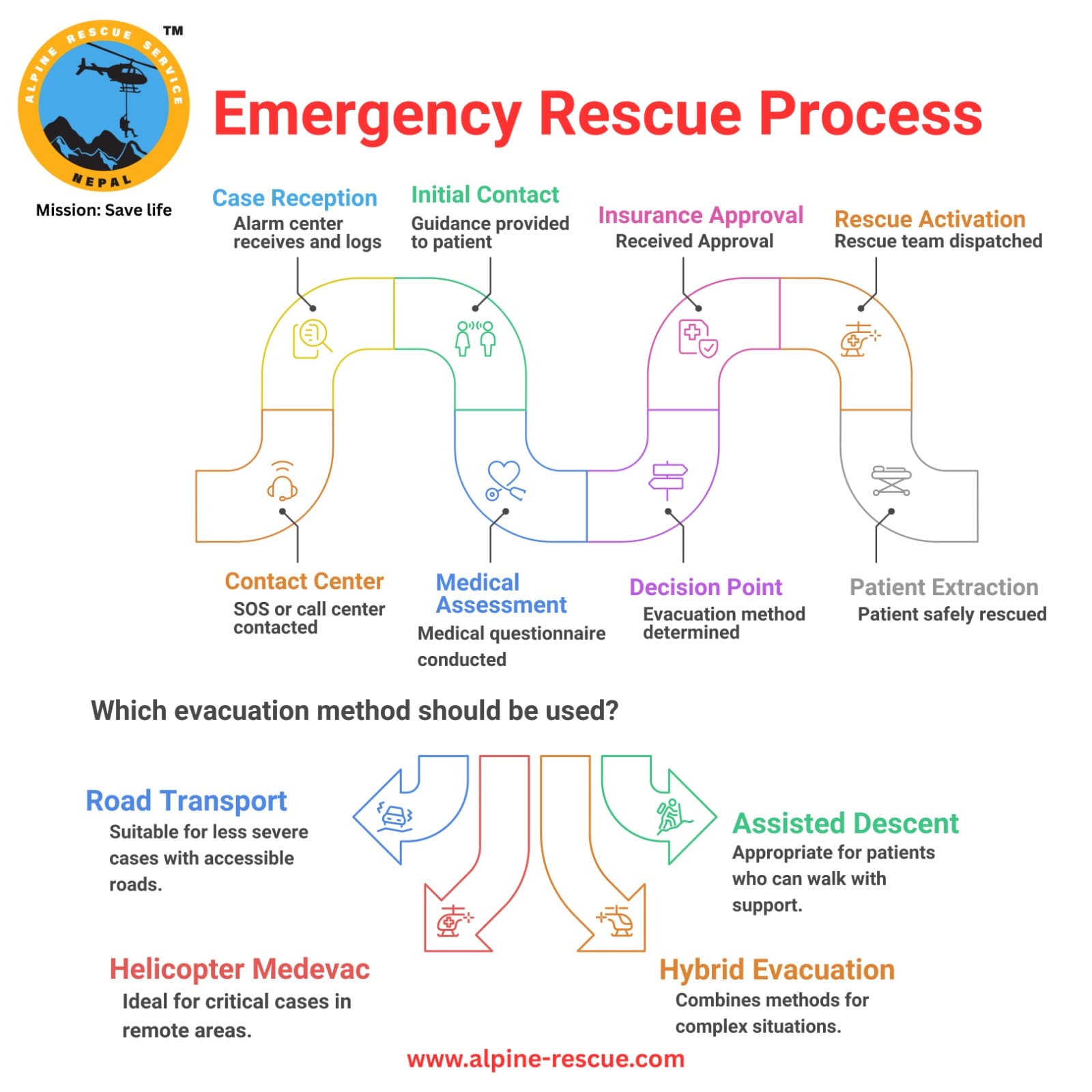
Field Action Matrix
Real-time coordination protocol between ground staff, aviation dispatch, and medical receivers during active high-altitude rescue operations.
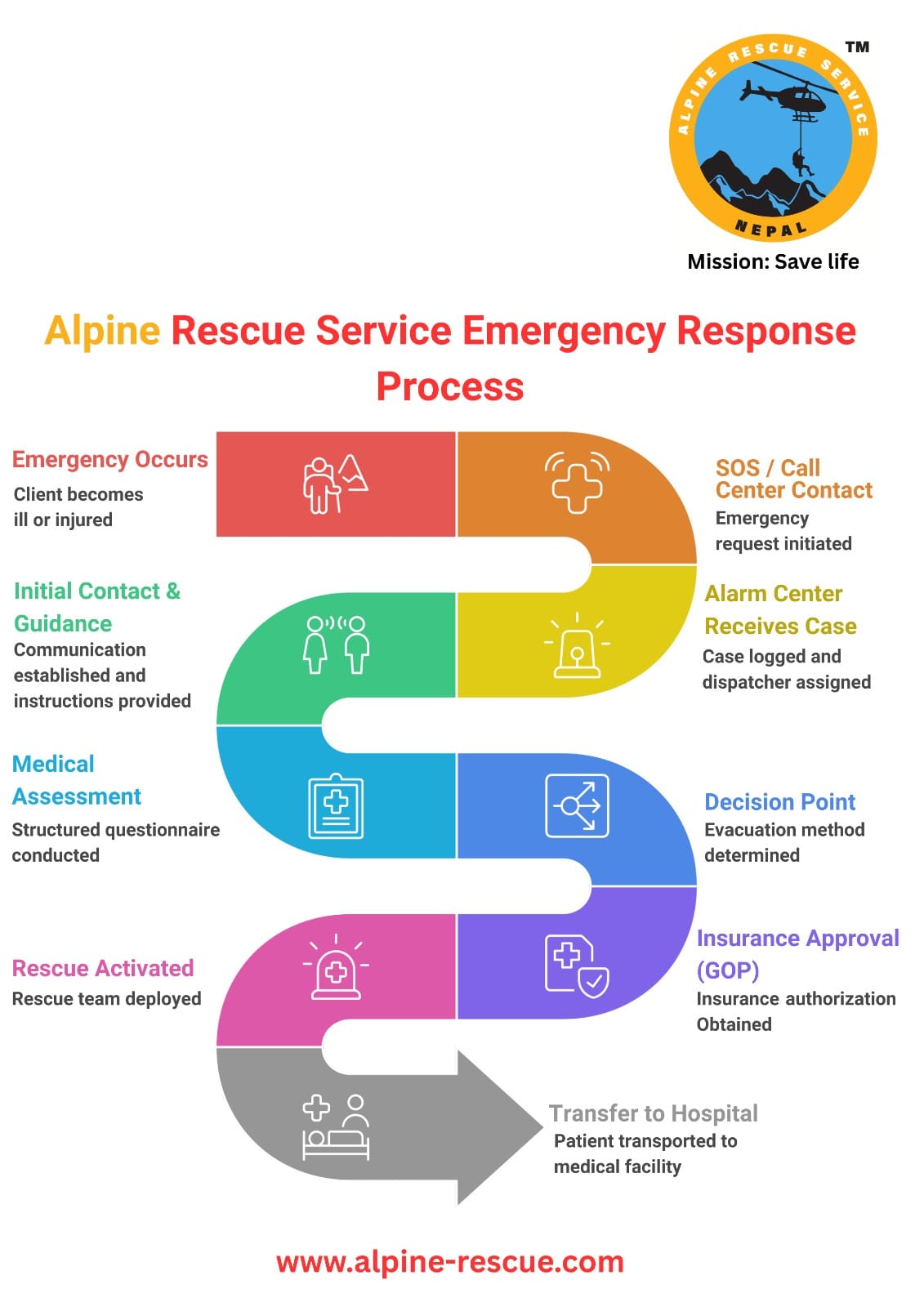
Dispatch & Response Protocol
The authoritative launch sequence ensuring zero administrative blind spots when deploying into extreme weather environments.
Operational Strength
Built for the world's most demanding terrain.
ARS provides insurers and assistance companies with a reliable, compliant, and experienced in-country partner — managing emergency cases with precision, accountability, and international standards.
Emergency Medical Evacuation, Search & Rescue, and Longline Rescue operations
Telemedicine capability with coordinated hospital network across Nepal
Cost control, containment, fraud monitoring, and billing integrity
Policy-driven assistance aligned strictly with insurer authorization protocols
Transparent case handling with full medical, operational, and financial documentation
Handling and repatriation of mortal remains with legal coordination
Active participant in global industry events including ITB Berlin and ITIC

Operational Commitment
“Every mission is executed with a clear mandate — safety first, medically justified action, and strict adherence to policy and governance frameworks.”
Resources
Company Dossier
The complete Alpine Rescue Service profile — fleet capabilities, medical certifications, team credentials, and operational track record.
Rescue & Emergency FAQ
Common questions about helicopter rescue coordination, evacuation costs, and emergency response in Nepal.
Still have questions? Contact usHGN's rescue coordination is active, not advisory. When an emergency is detected, HGN's team takes direct control: dispatching helicopter operators through established partner relationships, coordinating ground support, liaising with receiving hospitals, managing real-time communication via GPS, and ensuring financial clearance so there are no payment delays. HGN works with Alpine Rescue Service and IGI Prudential Insurance.
HGN targets rescue dispatch within 30 minutes of alert activation. Actual helicopter dispatch depends on weather, aircraft availability, and distance from the nearest airstrip. Most Himalayan trekking areas are within 30–90 minutes of helicopter reach, weather permitting.
Without insurance, helicopter evacuation in Nepal typically costs $2,000–$3,500 for shorter rescues, $4,500–$6,000 for Everest-region evacuations, and can exceed $7,500 for remote or complex rescues. CTG eliminates the need for upfront payment.
No. CTG uses direct billing — HGN coordinates payment directly with helicopter operators and hospitals on your behalf. You are not required to make an upfront payment. This eliminates the most common cause of rescue delay: financial clearance.
If you have a CTG plan and device: activate your SOS alert on the Tracer device immediately. HGN will respond. If you cannot activate the device, call HGN's 24/7 emergency number. Stay calm, remain in place if safe, keep the device charged and visible. HGN will guide you through next steps while coordinating rescue on your behalf.
Yes. CTG covers medical emergencies including sudden illness, accidents, and altitude-related conditions. If you experience any medical emergency requiring evacuation or hospital treatment during your covered trek period, HGN's rescue coordination team responds immediately.
In terrain where helicopter landing is impossible, HGN coordinates ground rescue: trained rescue porter teams, mule/horse evacuation to the nearest accessible point, and stretcher transport to a helicopter-accessible landing zone. CTG's GPS tracking ensures ground teams know your precise location.
Yes. All rescue and emergency services are available 24 hours a day, 7 days a week, 365 days a year. There are no business-hours restrictions on emergency response. HGN's platform and Alpine Rescue Service operate around the clock.

Help Is Never
Far Away.
Every plan includes 24/7 rescue coordination with an average response under 30 minutes.